Revisiting Sumarta
Kelvin Davies reports on his visit to North Sumatra and the remarkable transformation of rainforest once lost to illegal clearing.
A Return with Purpose
In 2021 supporters helped fund the planting of 64,000 rainforest trees. I wanted to see firsthand what those trees had become. What I discovered was inspiring.
As custodians of our donors' generosity, we have a responsibility to ensure every dollar entrusted to us delivers meaningful and lasting outcomes for nature. That responsibility brought me back to northern Sumatra in March 2025. I had two clear objectives: to assess the success of rainforest restoration projects supported by Australian donors and to identify opportunities where future investments could make the greatest impact.

Sumatran Orangutan
The Gunung Leuser Ecosystem
The Gunung Leuser Ecosystem is one of the most important rainforest landscapes on Earth. Covering almost 8,000 square kilometres across the provinces of Aceh and North Sumatra, it is the only place in the world where orangutans, tigers, rhinos and elephants still coexist in the wild. It supports an extraordinary diversity of life, including thousands of plant species and hundreds of species of birds, mammals, reptiles and amphibians.
Yet this globally significant rainforest has faced immense pressure.
Following the establishment of the national park in 1980, weak enforcement allowed widespread illegal clearing. Thousands of hectares of rainforest were converted into oil palm plantations, while ongoing encroachment by small-scale farmers further reduced wildlife habitat. Today, more than four million people live within or around the ecosystem, many relying on agriculture for their livelihoods.

One of the 500,000 trees planted in 2008.
Returning to a Place Once Lost
My connection with Sumatra began in 2008 when I first visited the Orangutan Information Centre (OIC), a conservation organisation founded and led by local Indonesians.
Back then, I stood on land that had once been rainforest but had been cleared and converted into industrial oil palm plantations. The scale of destruction was confronting.
Since that first visit, OIC has planted more than three million trees and become a global leader in rainforest restoration.
When I landed at Medan's Kualanamu International Airport in March, I was greeted by OIC founder Panut Hadisiswoyo. From there, we travelled directly to one of the first restoration sites I had visited seventeen years earlier.
I was eager to see what had changed.
From Oil Palm Plantation to Rainforest
The site covers 500 hectares of land that was illegally cleared during the 1990s and planted with oil palms. Restoring it was no small task.
The oil palms had to be removed, more than 500,000 native rainforest trees planted, and years of maintenance undertaken to ensure their survival. Temporary field stations were established to support restoration teams and help deter illegal logging, poaching and further encroachment during the critical early years.
Today, those temporary structures are gone. They are no longer needed. In their place stands a young rainforest. The transformation is extraordinary.

Millions of tree seedlings have germinated naturally.
A Forest Rebuilding Itself
Walking beneath the developing canopy, it was clear that restoration had reached a tipping point. Fast-growing pioneer species now provide shade and protection for slower-growing rainforest trees. Birds, bats and primates are dispersing seeds from nearby intact rainforest, accelerating natural regeneration throughout the site. Millions of seedlings have germinated naturally.
Drone footage revealed something even more remarkable. What was once an expanse of oil palms is now a continuous blanket of green rainforest stretching across all 500 hectares.
Standing among trees that were once seedlings is a powerful experience. It is tangible proof that degraded rainforest can recover when given the opportunity.
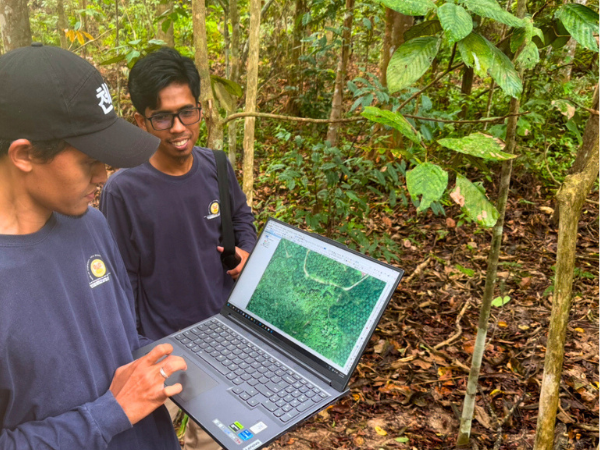
Using a drone to inspect the restoration site.
Wildlife Is Returning
The ultimate measure of success is not only the number of trees planted. It is the return of wildlife. Camera traps have captured images of orangutans moving through the restored forest. During our visit we found fresh elephant footprints, while monitoring programs have also recorded the presence of tigers. These are encouraging signs that the forest is once again functioning as habitat for some of Sumatra's most iconic and threatened species. The forest is alive again.

Camera traps have recorded orangutans and elephants.
Conservation That Changes Lives
One of the reasons OIC has been so successful is its commitment to local communities. Many people who once relied on activities that contributed to forest loss now earn an income through conservation and restoration. Community members are employed to grow and plant trees, maintain restoration sites, patrol forests, monitor wildlife, support rehabilitation centres for rescued animals, manage eco-tourism ventures and develop agroforestry projects. OIC also supports education through a local school serving more than 50 students. This approach creates lasting conservation outcomes because local people become partners in protecting the forest.
During my visit I also had the opportunity to meet with Aal, OIC's current Director, and witness the passion and professionalism of the next generation of conservation leaders.

Inspecting tree growth with botanist Rio.
A partnership and friendship endures
The relationship between Australian supporters and the Orangutan Information Centre extends far beyond financial support. Over the years, knowledge, skills and experience have flowed in both directions. OIC staff have visited restoration projects in Far North Queensland and northern New South Wales, while Australian rainforest regenerators and volunteers have shared expertise in Sumatra. Donor tours have also enabled supporters to see the impact of their contributions firsthand.
Together, we have learned that restoring rainforest is not only possible—it can be remarkably successful.
More Than Three Million Trees
Since planting its first trees in 2008, OIC has restored vast areas of degraded rainforest and planted more than three million trees. Australian donors have played an important role in helping make this achievement possible.
The results speak for themselves. Rainforest has returned and wildlife is coming back. Communities are benefiting and one of the world's most important ecosystems is stronger because people chose to act.

Growing trees in the nursery creates local employment.
A Small Investment. A Lasting Legacy.
The cost of planting a tree through OIC is just $2.00, including propagation, planting, community engagement and follow-up maintenance.
For the price of a cup of coffee, supporters can help restore habitat for orangutans, elephants, tigers and countless other species while supporting local communities and addressing climate change.
Few conservation investments deliver such lasting impact.
Thank You
As I stood beneath a rainforest canopy that did not exist seventeen years ago, I was reminded that nature can recover when people give it a chance. What was once an illegal oil palm plantation is now a thriving rainforest. That transformation belongs to every supporter who believed restoration was possible.
Thank you to our Australian and international donors whose generosity continues to make projects like this possible.
My visit to Sumatra was funded by an anonymous donor who recognised the importance of assessing conservation outcomes firsthand.
Together, we are helping restore one of the world's great rainforests—one tree at a time.
Kelvin Davies
Founder, Gondwana Rainforest Trust