Maalan Cloud Forest: a haven for native plants
More than 250 native plant species, including several high-altitude specialists and one endangered species, have been found during a vegetation survey of the Maalan Cloud Forest.
The tooth-billed bowerbird, found only in the dense rainforests of Far North Queensland, was also sighted during the survey carried out by botanist and ecologist Kristopher Kupsch on November 6.
“Its altitude, coupled by the rich fertile geology and high rainfall has accommodated a very diverse ecosystem,” Mr Kupsch said.
We need to raise $1.2 million before December 28 to purchase and protect this diverse ecosystem.
Please, act now and donate to help save the Maalan Cloud Forest.
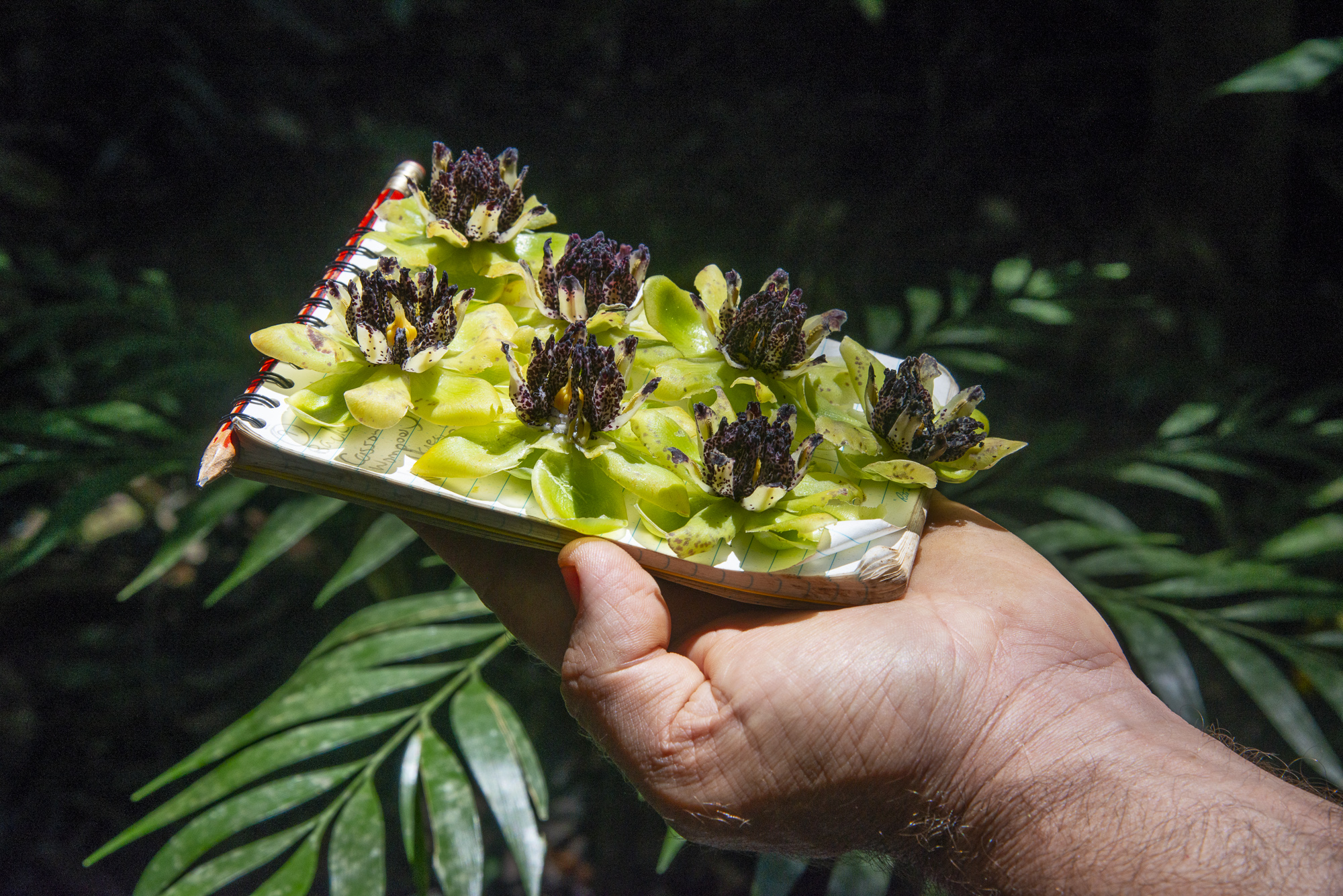
The flowers of the primitive and rare Austrobaileya scandens collected from the forest floor.
About the Maalan Cloud Forest property
The 83-hectare property sits from 750-850 metres above sea level and consists of red basaltic soil derived from the now-extinct Mount Fisher, northern Australia’s highest volcano.
Located between two large expansive forest tracts, the Maalan National Park and the Woroonooran National Park (both of which are listed as World Heritage Areas), the property is the 'missing link' to connecting these forests in the eastern Maalan region.
On the property, there are currently 45 hectares of endangered rainforest and 38 hectares of land that were cleared many decades ago and used until recently as cattle grazing land.

According to Kristopher Kupsch:
“Cattle grazing is the primary alien disturbance regime on the property hindering native regeneration and is the causation of all environmental concerns. The broad expanses of pasture additionally create edge effect to the forest exacerbating fragmentation. Fundamentally the ratio of forest core to forest edge is unnaturally high, creating many abiotic and biotic ecological changes.”
Put plainly, the historical clearing of this land has resulted in significant ecological effects.
The Maalan River also flows through the property and joins Phantom Creek which then becomes the South Johnstone River, one of the wildest rivers in tropical Australia. Its catchment possesses some of the best tropical rainforest in Australia.
We need to raise $1.2 million before December 28 to purchase and protect the Maalan Cloud Forest.
Please, donate now and help purchase and protect the Maalan Cloud Forest.
A rich diversity of plant species

Despite the fragmentation and edge effect caused by the clearing of land for cattle grazing, a rich diversity of plant species was recorded. From herbs, ferns and vines to shrubs to larger trees, a total of 253 native species and 23 exotic plant species.
One species, Rhodomyrtus pervagata, is listed as endangered on both the Environment Protection and Biodiversity Conservation Act 1999 and the Queensland Nature Conservation Act 1992. Once a common species, the Rusty Rhodomyrtus has suffered a drastic decline since 2010 due to an exotic plant pathogen called myrtle rust (Puccinia psidii). Myrtle rust flowers, fruit and new growth, causing persistent deformed growth and plant infertility. Specimens of this species appeared healthy and free of myrtle rust at the time of the survey.
Twenty-two native Laurel species were found, as well as higher altitude specialists including Helicia lamingtoniana and Jagera pseudorhus var. Integerrima.
In the best developed forest on the property, the highly locally endemic leguminous vine Ibatiria furfuracea was found to be abundant, as was the primitive Angiosperm Austrobaileya scandens.
This vine is rare and endemic to the Wet Tropics (and found nowhere else). It is the only species in its family and it is confined to very wet rainforests from low to upland altitudes. We identified multiple specimens on the Maalan Cloud Forest property that we are aiming to purchase for conservation.

Other significant plants occurring at the Maalan Cloud Forest:
- Coelospermum paniculatum var. syncarpum – a vine restricted to the Atherton Tablelands and associated mountains.
- Darlingia ferruginea – a tree restricted to the southern Atherton Tablelands.
- Helicia blakei – a small tree restricted to the Millaa region and perhaps Thornton Peak.
- Ibatiria furfuracea – a vine that has a very restricted natural distribution between the Maalan and Palmerston area.
- Polyalthia submontana subsp. sessiliflora – a small understorey shrub restricted to the high altitude rainforest of the southern Atherton Tablelands
- Urtica incisa – An otherwise common species in other regions of Queensland’s SE, this species has an isolated population on the Atherton Tablelands and a single collection in Mt Surprise. Its occurrence on the Maalan Cloud Forest property appears to be the most southern tropical collection to date.

All exotic plants identified on Lot 535 are associated with grazing practices, with the exception of small-leaved privet (Ligustrum sinense), which is a garden escapee taking advantage of cleared land.
We need to raise $1.2 million before December 28 to purchase and protect the Maalan Cloud Forest.
Please, donate now and help purchase and protect the Maalan Cloud Forest's invaluable ecosystem.

Evidence of the endangered southern cassowary was found in the Maalan Cloud Forest.
Wildlife abounds
The forested areas of Maalan are Regional Ecosystem 7.8.4, and categorised as essential habitat for the endangered southern cassowary (Casuarius casuarius johnsonii). While no cassowaries were sighted during the survey, a very high number of Cassowary food plants were recorded and there was evidence of their presence in the form of old scats and even aged seedling cohorts, originating from old droppings.
Birds observed during the vegetation survey included the tooth-billed bowerbird (which is listed as near-threatened by the IUCN), catbirds, owls and pigeons.
As the property is situated in a central location which facilitates the movement of animals across the landscape, it’s expected that Lumholtz’s tree-kangaroos and other threatened arboreal marsupials occur on the property.

Lumholtz's tree-kangaroo
Kristopher Kupsch also found that platypus were almost certain to occur within streams on the property.
“Due to the high fertility soil, there is to be expected a high diversity of faunal species, especially high altitude marsupials and insects,” he noted in his report.
“This, considered alongside animal life…. which uses this property, not forgetting fungi etc, means the overall species diversity for this property as a whole could equal close to one thousand.
“Many of these species are high altitude cloud forest specialists, of which the sheer volume are threatened by anthropogenic rapid changes in climate.”
Please, donate now and help purchase and protect the Maalan Cloud Forest.

A large population of the endangered spectacled flying-fox uses a camp near the property. Pic by David White.
A property worth saving
We need to raise $1.2 million before December 28 to purchase and protect the Maalan Cloud Forest.
If successful, we will revegetate the cleared land to complete a high-priority corridor between Maalan and Wooroonooran national parks.
Our plan is to protect the Maalan Cloud Forest property through its gazettal as a Nature Refuge. The Queensland Government’s Nature Refuge program works with landholders who have an interest in protecting and managing the significant conservation values of their land in perpetuity. A nature refuge is established through a voluntary, binding conservation agreement between the landholder and the Department of Environment and Science on behalf of the Queensland Government. Nature Refuges provide the highest level of protection for land outside of a national park.
Our project partners are South Endeavour Trust, a successful registered non-profit organisation that acquires and manages land for conservation. We successfully partnered with them in 2021 for the acquisition of Oakey Scrub near Cooktown and the Cheelonga Cloud Forest in 2022.

The Maalan River flows through the property.
The purchase, protection and restoration of the Maalan Cloud Forest will also help buffer the World Heritage Area.
Please, donate now and help purchase and protect the Maalan Cloud Forest.